There’s a myth that keeps a lot of would-be musicians on the sidelines: That if you didn’t start an instrument as a kid, it’s too late. That your fingers are too old, or your ear is too untrained, or that you just don’t have the time to learn.
Nine cellists are here to tell you that myth is wrong.
We asked members of our Cello Discovery™ community – an online learning platform for adult cellists –, to share their experience. What came back was an inspiring group of adults telling the same story from different corners of the world: That it is truly never too late to start.
They range in age from their 40s to their 80s. They live in Pennsylvania and Florida, Texas and Missouri, California, Thailand, Australia and New Zealand. One is a retired professor. One builds custom homes and homeschools six kids. One is an aerial performer who bought a cello on a hunch and never looked back. What they share is this: every single one of them decided, as an adult, to learn the cello, and every single one says it changed their life.
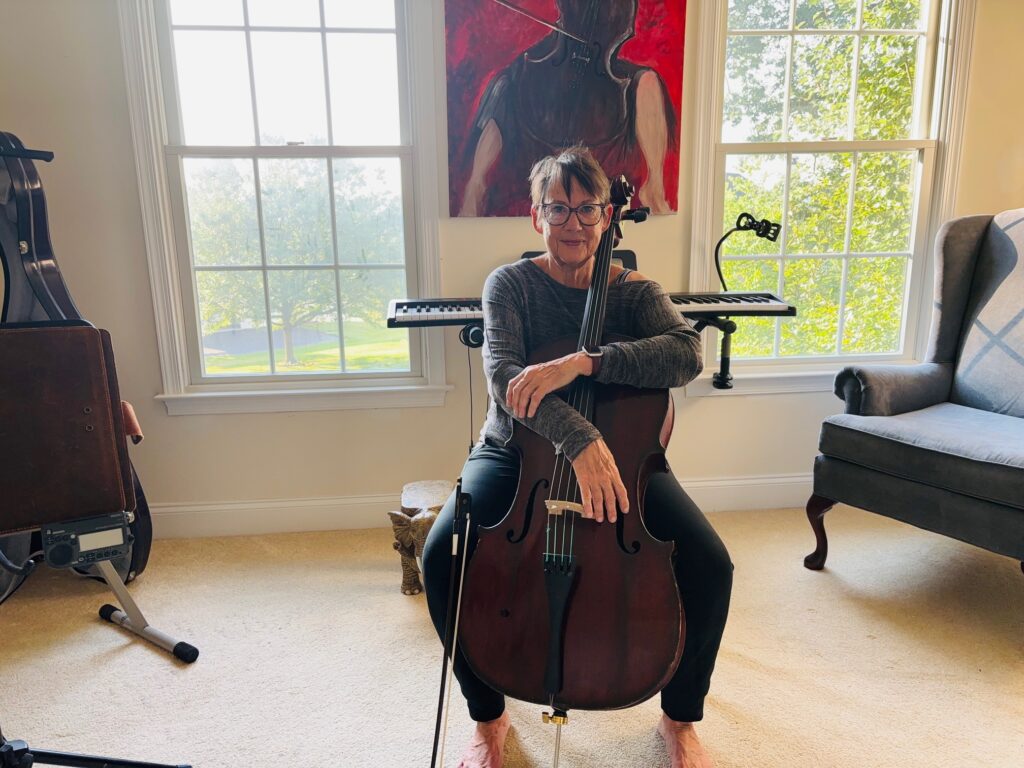
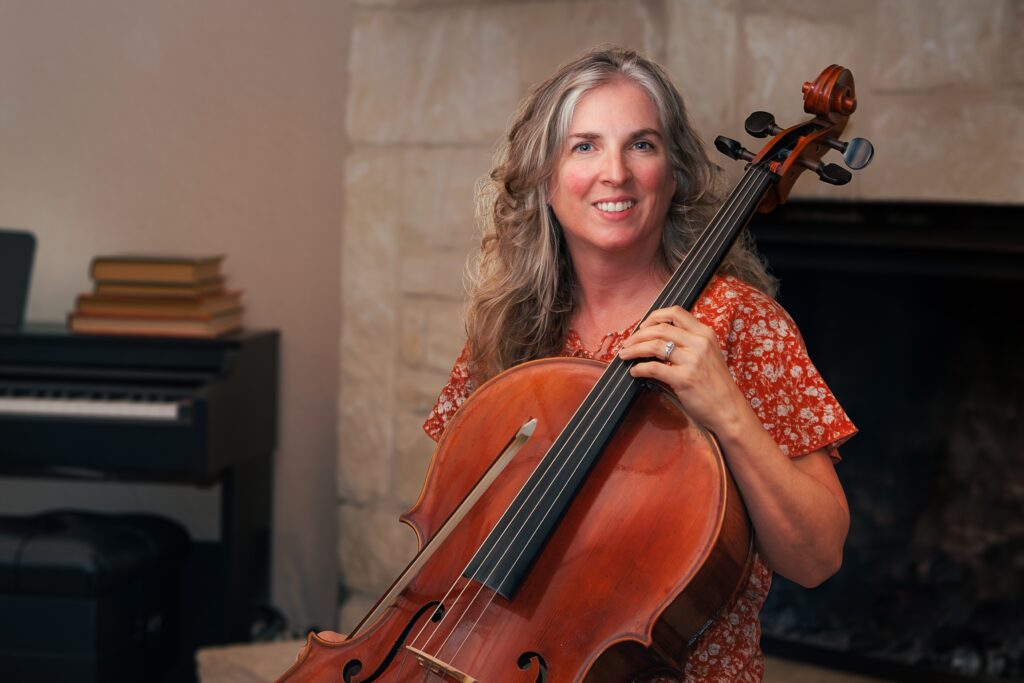
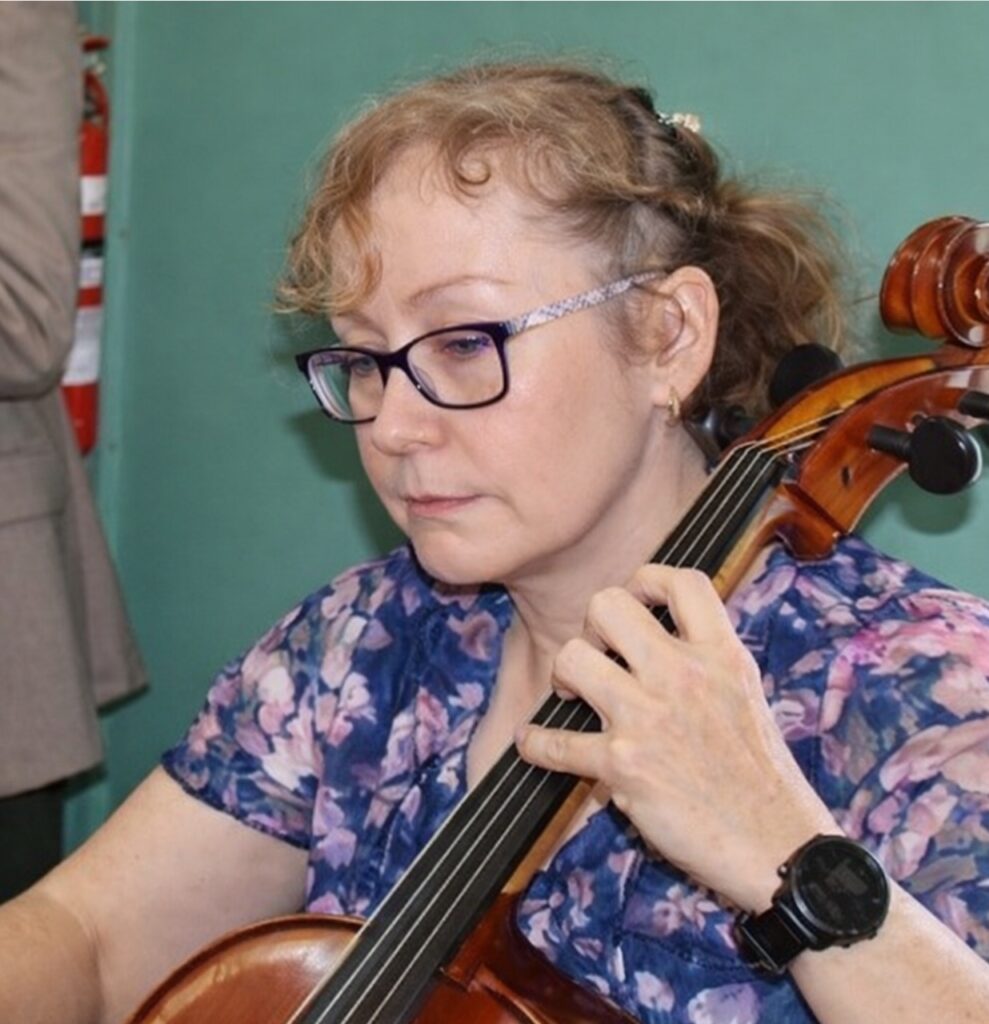
“Life Is Precious”: Why They Finally Picked Up the Cello
For almost everyone who contributed their story, there was a moment when the idea of learning cello stopped being a one-day-in-the-future thing, and became a reality.
For Sally Panigel, who splits her time between Exton, Pennsylvania and Vero Beach, Florida, that moment arrived during the isolation of COVID-19. A former piano teacher and multimedia developer who emigrated from South Africa to the U.S. (by way of Germany), Sally had always loved the cello’s sound and shape from her days performing piano concertos as a student.
But it took a pandemic to make the dream feel urgent. “During COVID, I realized that life is precious and it could slip through my fingers at any moment,” she says. “The idea of learning the cello, my lifelong wish, became something tangible and I decided to pursue this dream and make it a reality.”
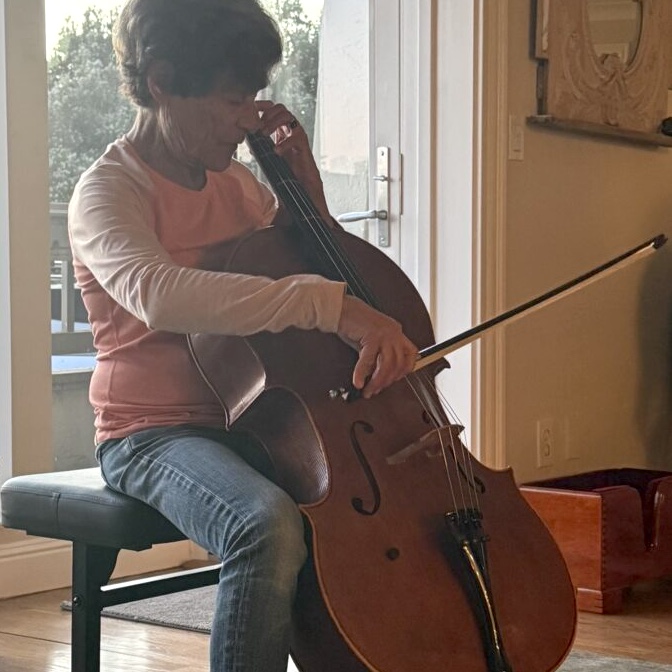
Jody Newman of Tiburon, California, waited even longer – until retirement, at age 80. “I’ve always thought it was the most beautiful instrument by far and wondered if I could learn to play, and finally had the time to try when I retired,” she says. She rented a cheap cello and a $20 bow from a local guitar shop and started lessons. She broke her wrist seven months in and had to take three months off. She kept going anyway. Now 82, Jody is proof that “too old to start” simply isn’t even a thing!
For Letitia Scott in Brisbane, Australia, the cello arrived out of loss. A former early-childhood special-needs educator, Letitia had to medically retire after COVID took her voice. She’d also lost her ability to play the French horn, an instrument she loved for its rich tone. “I wanted an instrument that could sing,” she explains, “so I gravitated towards cello after briefly trying a violin and exclaiming that it was too squeaky.”
Anja Geelen of Wellington, New Zealand, started at 59 after a medical event reordered her priorities. “Age should not be a barrier to not do what I want to do,” she realized. She needed something to support her recovery, and the pull toward the cello (plus what she calls its “rewiring” benefits for the brain) made her take the leap.
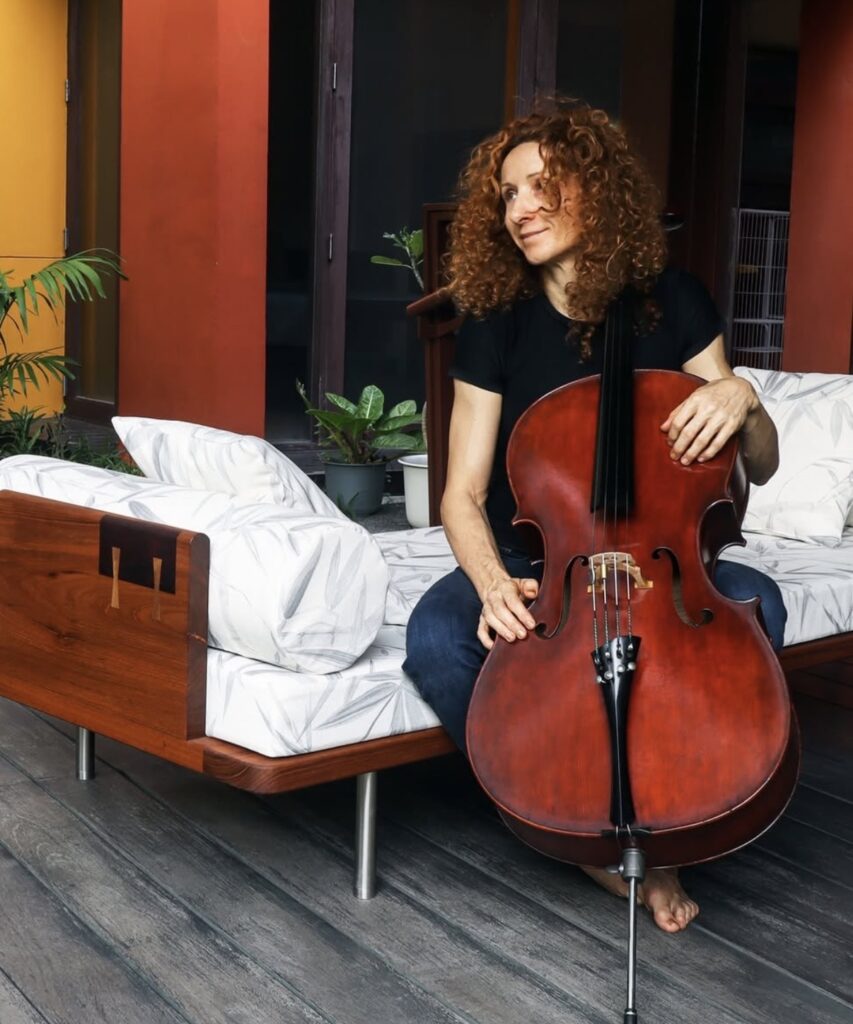
Then there’s Elodie Pinel an aerial performer based in Bangkok, Thailand, whose path to the cello is unlike anyone else’s on this list. Searching for fresh music for her aerial dance acts, she stumbled on a video of a performer she admired playing alongside a cellist. “For reasons I can’t fully explain, it felt like a calling,” she says. “I had no musical background, no sense of rhythm or intonation despite being a dancer. Yet the very next day, I impulsively bought a student cello, not even sure if I would enjoy it – just trusting that gut feeling. That decision changed everything. It became one of the best choices I’ve ever made.”
Some, like Rose Griffin of Nelson, New Zealand, wanted a new challenge to fill retirement. A former visual arts educator, she’d sung in choirs for years but “wanted a new challenge & wanted to be able to play in an orchestra.” Today she plays in two orchestras and a string group.
Others, like Denise Burrell of Strafford, Missouri, had a very sweet reason. A retired teacher and administrator who plays piano and accordion in her family band, Denise started cello at 51 for one reason: “My daughter is a professional violinist/vocalist and I wanted to be able to play duets with her someday.”
And for Kyong Chee a retired university professor in San Marcos, Texas, the deciding factor was permission. Permission she didn’t know she needed until her father-in-law, a career music professor, gave it to her. She’d always loved the cello’s sound but doubted whether an adult with no formal music training could really learn an instrument. She asked him directly if he thought she could do it. “His answer was ‘Yes.” She remembers the major obstacle being a negative attitude and a lack of confidence.” Soon after, a friend introduced her to a cello teacher. “That’s how it all began.”
Playing With Others: “A Language We All Understand”
Ask any of these nine cellists about their favorite moment so far, and the answer is rarely about playing alone. It’s almost always about playing with someone else.
Sally describes joining a Cello Discovery workshop with a large group of cellists as a full-body experience: “I can still remember and feel the enormous sympathetic vibration of my body and mind as 20-plus cellists drew their bows across the A string to tune – the emotion that welled up in me is indescribable. I would do everything in my power to make music with others, there is nothing like it. It’s a language that we all understand, words not necessary.”
Grace Gobart, a mother of six in La Vernia, Texas, who runs a home-construction business with her husband while home-schooling her children, had the chance to play cello at a close friend’s wedding this past February.
“My cello part was very simple and supportive to the violins and piano, but many people expressed to me how much richness the deep cello tones added to the pieces,” she says. “Yes, I was nervous, and felt inadequate, but I would absolutely do it again if given the opportunity. The joy doubles, and triples, and quadruples when you play with other musicians!”
Elodie found the same magic in duets with fellow cellists. “All the hours of practice suddenly became alive when shared with another musician – their voice intertwining with mine in seamless harmony,” she says. “To feel our own sounds melt together into something greater than either of us alone was nothing short of extraordinary for me.”
Letitia now plays adapted cello parts in a local chamber orchestra – an experience she calls “thrilling and scary and challenging all rolled into one” And another time she played a friend’s original composition at a wedding. Through the local chamber orchestra, she reconnected with a high school friend she hadn’t seen in thirty years. “I didn’t believe it when I walked in with my cello and there she was,” Letitia says. “So learning cello is super amazing for developing friendships and deepening shared interests.”
Kyong played a duet her father-in-law transcribed specifically so they could perform together. “I was super nervous and did not stay in tempo at first,” she admits. “When we tried playing again, it was successful and enjoyable.” She’s since also played with a violist at an assisted living community.
Denise now plays in string trios and quartets and performs several concerts a year with her local community orchestra – music she describes as “always a tremendous challenge,” often on par with what the professional symphony in her area performs. This fall, she’s forming her own string trio with a violinist and violist.
Even Jody, who worries she’s not yet at the level for a local group, has played duets with friends and calls her Cello Discovery workshop experience “amazing, fabulous, wonderful.”
More Than an Instrument: How Cello Changed Their Lives
Every one of the nine described an impact that reached far beyond music.
For Jody, the cello filled a space she didn’t know was empty. “It has added a whole new dimension to my life,” she says. “It’s wonderful to have something new and challenging at my age that I can work on and improve at and think about and look forward to… I can’t imagine my life at this point without the cello, even though I only started two years ago. If I couldn’t play, it would leave a huge hole in my life.”
Anja describes her daily practice as something close to medicine. “I call it my vitamin C(ello),” she says, “which with all other vitamins, supplements and healthy nutrients and daily movement adds to my daily ‘fitness programe’ to keep my cortisol levels low. I feel accomplished and elated after a practice. It is my happiness hormone. It refuels my heart tank.”
Rose finds the discipline itself restorative. “Cello practice is very mindful, I think, with the repetition & attention to detail,” she says.
Kyong‘s list of what the cello gave her reads like true self-awakening: more self-knowledge, a deeper appreciation for music, more confidence in her own dexterity and ear, and – surprisingly – the courage to try other new things, like learning languages. “The confidence needed for auditioning for a barbershop chorus could not have been there had I not had the experience of reading music and learning the cello,” she says. It also taught her something about balance: “I became better at allocating some of my time for ‘playing’ instead of ‘working.’ Previously I did not think I could afford picking up any hobbies or having any interest outside of my career.”
For Elodie, the cello reopened a door she’d shut as a child. “Since childhood, I longed to sing or play an instrument, though I often felt out of tune and clumsy,” she says. “I buried that dream deeply – until the moment I saw a cellist performing in an aerial arts act. In that instant, I knew I had to try. Taking the step beyond my own limitations felt like granting myself permission to live that dream.” Learning cello, she says, has helped her break free from a lifelong sense of clumsiness and given her “a new sense of possibility.”
Grace watches the ripple effect move through her own household. Learning cello takes “a lot of work, commitment, and focus,” she says, “but most rewarding is the inspiration I believe I am to my children, who see me learning this beautiful instrument, and now desire to join me in the music making.”
Sally, meanwhile, points to the cello community itself as one of the biggest gifts. “My days are full,” she says. “I have met wonderful people, I have made incredible friends, connections across the world, I have gained understanding and appreciation for the skills required by cellists… and I have also gained new electronic skills.”
The Hard Days: How They Push Through Frustration
None of this came easily, and none of them pretend it did. Learning a demanding instrument as an adult means bad days – plenty of them. But what sets these nine apart is what they do with it.
Sally counts on ritual when nothing seems to be working. “I listen to music, reach out to my community and friends, take a walk, then I go back and just play open strings and try to make the most beautiful sound I can, and try to feel my cello vibrate, then one note, then another, then another,” she says. “I am stubborn. Those days when nothing works, I know it’s me and not my cello – she will be there when I am ready.”
Jody has never once considered quitting, and she’s thought hard about why. “It’s harder to learn to play the cello as an old adult than as a kid,” she says candidly, “but I never have wanted to quit… there are some advantages to learning as an adult – no one is making me practice. I am doing it because I want to, and it might mean more to me than it does to a kid.” On the tough days (and there are days she watches fourteen-year-olds outplay her, or feels like she’s gone backward overnight) she credits a supportive teacher, the Cello Discovery community, and simply liking a hard challenge.
Grace steps away entirely when frustration hits. “I step away from my cello, find a quiet moment, and turn on my play list of my most-loved cello pieces,” she says. “Hearing my favorite cellists play is immensely inspirational and does wonders to renew my motivation.” She also credits her “cheering section” – her family and online cello community – with keeping her moving forward.
Denise makes physical reminders of her progress. “I make little signs of encouragement to hang in my practice room,” she says. “When I am about to give up, I look at those and feel hope again. It also helps to go back to old repertoire that I used to think was impossibly difficult and realize, hey, I can actually play that now!”
Letitia borrows a line from Anne of Green Gables: “Tomorrow is a new day with no mistakes in it yet.” On the roughest days, she retreats to basics. “I just go back to plucking or open strings practice,” she says, “then end on a positive for my practice session.”
Anja turns outward. “I share my frustrations with my cello friends,” she says. “They always have my back. They cheer me on, no matter what. They show me I am not alone on this wonderful cello journey.” When words aren’t enough, she watches instructional videos until the specific thing frustrating her starts to make sense.
Kyong found that frustration was often a sign she needed a different kind of help, not just more solo practice. Displeased with her sound, she eventually found a new teacher who went back to fundamentals with her – literally how to sit and hold the cello – and progress followed.
Elodie, learning in Thailand where adult cello students are rare, leans hard on her online community. “What has helped me most is trusting the process, and remembering that discipline beats everything,” she says. “Knowing that others are walking the same path makes the journey less isolating and reminds me that perseverance is part of the artistry itself.”
And Rose, for her part, says simply:
“I haven’t felt like giving up at any point. Having access to the orchestras has been a big added bonus.”
Their Advice to You
If there’s a thread running through all nine stories, it’s this: age was never actually the obstacle. Fear was. Every one of these cellists had to talk themselves past the voice that said you’re too old, too busy, too untrained, too late.
Anja puts it best: “Don’t let the dream stealers take your dream away. Find someone to champion you. If it isn’t your family or your friends, there is a wonderful uplifting community of cello players… They have been there for me, and they will be there for you.”
Elodie describes the community she found the same way: “What makes it so special is the shared love of the cello – without judgment, without the belief that we are ‘too old’ or ‘untalented.’ This journey has shown me that music is not about perfection, but about connection, courage, and joy.”
Kyong sums up what a late start in life can actually mean: “My late stage of the life course has become a period of continued personal growth and expansion.”
And Sally, echoing the moment that got her started in the first place, offers the simplest reminder of all – that the only thing standing between you and the instrument you love is deciding to start.
So, is It Really Too Late to Learn the Cello as an Adult?
Based on nine very different stories, spanning five countries and four decades of starting ages – the answer is a resounding no – it’s not too late. Whether you’re 40, 60, 80… whether you have a musical background or none at all, whether you’re picking the cello up out of grief, or a life-long curiosity, retirement boredom, or a sudden calling – learning the cello IS something you can do.
Special thanks to Sally , Jody , Grace, Denise , Rose, Elodie , Letitia , Anja , and Kyong for generously sharing their stories. And to the Cello Discovery community for supporting one another across the globe.